Learning Resources

Tanpopo Kids – Japanese online lessons for kids

Konnichiha! Halo para Ayah dan Ibu!

Saya Astrid, ibu dari tiga anak (umur 2 tahun-kelas 3 SD) dan sudah tinggal di Jepang hampir 20 tahun.

Beberapa kali saya lihat ada anak-anak yang sekolah di Jepang, tapi belum fasih berbahasa Jepang, jadi mereka kesulitan dalam berinteraksi dengan teman dan guru, dan juga kesulitan dalam proses belajarnya.

Kita semua tahu bahwa kemampuan bahasa sangat vital baik untuk anak-anak maupun orang dewasa bukan hanya untuk alat berkomunikasi, tapi juga sebagai alat utama untuk menyerap ilmu dan mempelajari skill apapun itu.

Program ini khususnya saya tawarkan untuk anak-anak yang orangtuanya belum fasih berbahasa Jepang dan perlu bantuan untuk mengajari anaknya bahasa Jepang.

Harapan saya yang terbesar adalah setiap hari anak-anak Ayah dan Ibu lebih enjoy pergi ke daycare atau sekolah dari pagi sampai sore, bisa ngobrol dengan teman-teman, bisa paham dan merespon instruksi atau panduan dari gurunya, dan sedikit demi sedikit bisa mengerjakan PR atau tugas sekolah dengan lancar.

Fitur program

  1. Bahasa pengantar dalam bahasa Inggris atau Indonesia: Bahasa kedua yang dipakai di Jepang adalah Bahasa Inggris. Jadi saya selalu menyarankan murid-murid saya yang levelnya pemula untuk belajar bahasa Jepang dalam bahasa Inggris. Tapi tentunya saya akan sesuaikan dengan kondisi muridnya dan saya bisa sampaikan juga dalam Bahasa Indonesia bila diperlukan.
  2. Pelajaran dalam huruf Hiragana, Katakana, dan Kanji: Untuk murid yang sama sekali belum bisa baca tulis huruf Jepang, akan saya bantu dengan huruf alfabet, tapi tetap dengan target menguasai tiga jenis huruf Jepang.
  3. Kemampuan komunikasi: Murid akan belajar mengekspresikan pikirannya secara verbal dengan topik pembicaraan yang saya sesuaikan dengan minat atau hal yang familiar.
  4. Review pelajaran di sekolah: Anda bisa sampaikan topik pelajaran yang ingin direview atau perlu dibantu untuk pemahamannya, misalnya sansuu (算数, pelajaran Matematika) atau kokugo (国語, pelajaran Bahasa Jepang).

Biaya

750 yen/kelas (30-menit, Zoom)

Hari Senin-Jumat, 14:00-16:00 (Japan time)
Bahasa pengantar: Bahasa Indonesia atau Inggris (bisa pilih)

Ada diskon untuk yang ambil 8 kelas per bulan.

Transfer via Japan Post paling lambat sehari sebelum kelas dimulai.

Cara Bergabung

Silahkan hubungi saya Astrid di nomor WA ini:

+81-80-2820-0107

Terimakasih dan sampai ketemu di kelas saya!

Astrid

Learning Resources

Program Belajar Bahasa Jepang Online Untuk Para Ibu di Jepang

Konnichiha! Halo Moms!

Saya Astrid, ibu dari tiga anak (umur 2 tahun-8 tahun) dan sudah tinggal di Jepang hampir 20 tahun.

Saya ingin membantu sesama ibu yang tinggal di Jepang supaya bisa lebih lancar dalam berkomunikasi sehari-hari dan membesarkan anak-anaknya. Program ini cocok untuk Anda yang tidak bisa sama sekali tentang bahasa Jepang atau baru mulai belajar. Nanti Anda tidak hanya belajar tentang tata bahasa, tapi juga sistem dan fasilitas yang ada di Jepang yang berkaitan tentang membesarkan anak.

Fitur program

  1. Kurikulum yang Berfokus pada Anak: ekspresi dan kosakata bahasa Jepang yang diperlukan untuk membesarkan anak-anak pada berbagai tahap, mulai dari bayi hingga anak-anak usia sekolah dasar.
  2. Pelajaran yang Mudah Dipahami untuk Pemula: Pelajaran dalam huruf alfabet dan Jepang untuk memfasilitasi peserta dengan berbagai kemampuan membaca.
  3. Keterampilan Komunikasi: Anda bisa berlatih percakapan (kaiwa) dengan lafal yang benar karena ini kunci penting dalam komunikasi lisan.
  4. Komunitas para ibu: kita bisa bertukar informasi tentang parenting dan menambah teman sambil belajar bahasa Jepang.
  5. Fleksibilitas: Semua sesi direkam, jadi Anda bisa lihat ulang sesuai jadwal yang Anda bisa.

Topik yang Dibahas dalam Program

  • Kesehatan Cara membuat reservasi RS/klinik, imunisasi, check-up rutin, cara berkomunikasi dengan staff medis dan apotik, membaca boshi techou (maternal and child health handbook), membaca spesifikasi obat, dsb.
  • Pendidikan/Daycare Memahami sistem dan cara berkomunikasi di lingkungan pendidikan, termasuk daycare (hoikuen), TK (youchien) dan sekolah).
  • Aturan Lalu Lintas Mengenal kosakata dan peraturan lalu lintas Jepang sebagai pejalan kaki atau pengemudi kendaraan.
  • SIM (Surat Izin Mengemudi) Mengenal sistem SIM di Jepang.
  • Membaca label barang, termasuk makanan/minuman Mempelajari informasi di label barang, misalnya kandungan dan alergen, cara membuat/memasak, cara penyimpanan, dsb.
  • Arubaito (kerja part time) Mengenal sistem melamar kerja dan juga contoh lowongan kerja yang cocok untuk ibu rumah tangga.

Biaya

300 yen/sesi (bisa dibayar per sesi atau per bulan)

Transfer via Japan Post sebelum mulai sesi.

Cara Bergabung

Silahkan hubungi saya Astrid di nomor WA ini:

+81-80-2820-0107

Untuk yang ingin lihat profil saya, silahkan klik di sini atau kunjungi YouTube channel saya.

Terimakasih dan sampai ketemu di kelas saya!

Astrid
Learning Resources

Belajar Bahasa Jepang dengan alfabet biasa (Romaji)

Konnichiha! Halo semua!

Apakah Anda salah satu dari kategori ini?

Tertarik dengan bahasa Jepang tapi tidak punya waktu untuk mempelajari huruf-huruf Jepang yang jumlahnya sangat banyak dan rumit?

Bekerja di perusahaan yang berhubungan dengan Jepang dan memerlukan komunikasi dasar dalam bahasa Jepang?

Ingin jalan-jalan ke Jepang dan bisa berkomunikasi tanpa alat/aplikasi translator?

Ada rencana dinas ke Jepang dan ingin bisa berkomunikasi dengan bahasa Jepang dan menyiapkan pengetahuan dasar tentang budaya kerja dan manner di Jepang?

Ingin belajar dari tutor yang tinggal dan punya pengalaman kerja kantoran di Jepang?

Kalau jawabnya IYA, saya Astrid bisa bantu Anda dan selamat datang di program:

Kursus Online Bahasa Jepang dengan Huruf Romaji (Alfabet)

Program ini saya siapkan khusus untuk pemula yang tidak bisa membaca huruf Jepang dan juga tidak memiliki waktu untuk mempelajarinya, seperti pegawai kantoran dan pengusaha yang jadwal kerjanya padat dan juga yang punya anak-anak. Saya paham sekali dengan situasi ini karena saya pernah kerja full-time kantoran dan juga ibu dari tiga anak.

Saya juga sudah melihat banyak orang asing di Jepang yang lancar berkomunikasi secara verbal dengan Bahasa Jepang tanpa bisa membaca hurufnya. Kemampuan berkomunikasi ini tentunya sangat membantu di berbagai aspek dibandingkan kalau tidak bisa berbahasa Jepang samasekali. Jadi, apakah bisa langsung mempelajari kosakata dan grammarnya tanpa menguasai hurufnya? Tentu saja bisa! Kalau Anda bisa membaca alfabet, berarti Anda bisa mempelajari bahasa Jepang.

Video-video yang saya siapkan untuk program ini durasinya rata-rata 5 menit karena saya yakin setiap orang pasti bisa meluangkan waktu 5 menit tiap harinya. Kalaupun durasi ini masih terlalu panjang untuk Anda, silahkan pelajari videonya sesuai ketersediaan waktu Anda, kapan saja, di mana saja.

Program STANDARD:

  • 2 pre-recorded video setiap minggunya, dengan durasi 3-7 menit per video
  • Grammar notes (PDF) dan akses daftar kosakata
  • Homework menulis, mendengar, dan merekam suara Anda
  • Feedback dari saya untuk kemajuan Anda
  • Biaya: Rp. 745.000 per bulan

Program PREMIUM:

  • Semua yang ada di program STANDARD
  • Satu sesi les privat 30 menit dengan saya setiap minggunya
  • Pembelajaran dengan konten yang fleksibel sesuai bidang/kebutuhan Anda
  • Biaya: Rp. 1.350.000 per bulan

Program ini mulai berjalan bulan Mei Silahkan kontak saya dan nanti saya kirim beberapa sample video supaya Anda bisa lihat isinya.

Selain itu, Anda juga bisa reservasi satu kali les privat 30-menit gratis untuk mencoba. Jangan kuatir, tidak akan ada pembayaran apa-apa samasekali sampai Anda resmi mendaftar di program ini.

Jadi, tunggu apa lagi? Untuk informasi lebih lanjut dan pendaftaran, silakan kontak saya via:

WA: +81-80-2820-0107

FB: @multilingualtanpopo

Instagram:@multilingual_tanpopo

Arigatou gozaimasu.

Sampai ketemu di kelas saya!

(Ibu) Astrid

Learning Resources

Enhance Your Business Communication Skills with Indonesian Language Course

Selamat siang.

Are you a business professional looking to master Indonesian language skills for smoother communication in your workplace? Look no further! As a native Indonesian speaker and former translator/interpreter in a Japanese automotive company, I understand the importance of clear pronunciation and natural speech intonation, especially in the business environment. 

Unlike many other language learning resources, my exclusive Indonesian language course offers a unique blend of authenticity and natural speech intonation specifically tailored for business professionals like you. This approach ensures that your communication is not only effective but also culturally appropriate, setting you apart in your workplace.

By enrolling in my course, in addition to grammar, you’ll learn essential vocabulary for your workfield and master the nuances of Indonesian intonation and speech patterns. These skills will help you build stronger relationships with local staff and clients and enhance your business prospects, making you a more effective and confident communicator in the workplace.

I offer flexible weekday class timings from 8 AM to 3 PM JST, with morning and lunchtime sessions being the most recommended times. Scheduling adjustments within working hours are also available to accommodate your busy schedule. Each lesson is fully customizable, ensuring that you learn vocabulary and phrases relevant to your specific field of work. Just let me know the field or content you want to learn, and I’ll prepare the material exclusively for you. 

My comprehensive program includes:

  • Fully private live classes.
  • 24-hour lifetime access to a carefully curated vocabulary list.
  • Engaging assignments.
  • Shadowing practice to reinforce your learning.

The monthly course fee for four classes typically ranges from 6000 yen to 10000 yen (41 USD to 68 USD per month, depending on the content and difficulty level. Need more or fewer classes? No problem at all. I can provide several options that align with your budget and work schedule.

This course is a valuable investment that will bring you long-term benefits and boost your career opportunities. Contact me today for more details and to book your free 30-minute consultation. Join my class, and let me guide you toward greater success in your professional endeavors.

Terimakasih dan happy learning!

Learning Resources

ビジネスインドネシア語コース

こんにちは! Selamat siang.

インドネシア語を職場で使いたいですか?

現地の取引先とインドネシア語でやり取りをしたいですか?

今まで習ってきた一般的なインドネシア語をキャリアアップのためにビジネスレベルに向上させたいですか?

私アストリッドが手伝います!

インドネシア語の単語がわかっても、発音が間違ったら、まったく伝わらない場合が少なくありません。発音が正しくても、イントネーションや使う単語がニュースや空港内のアナウンスのセリフみたいな話し方で話したら、聞き手にとっては、違和感が感じてしまいます。このような問題点は私のクラスで一つずつ解決します。話相手に対してより適切で、自然なインドネシア語の発言ができるように一緒に練習しましょう。

レッスンの曜日・時間

平日の午前8:00時から午後3時半になります。

※レッスンはZoomにて行いなます。

レッスン内容

基本文法やビジネスシーンでよく使われるフレーズ等が主な内容になりますが、無料体験の時にお聞きしますので、ご希望に合わせ、こちらから用意いたします。

レッスンで使う言語はインドネシア語・日本語ですが、英語も対応可能です。英語能力も同時に上達させたい方は、是非ご相談ください。

定期レッスン

入会金 ¥2300

月4回、1回35分レッスン:6800円

月2回、1回35分レッスン:4000円

曜日と時間はご希望と講師が対応できる時間帯を伺って設定致します。

当日キャンセル等による振り替えレッスンは、月1回に限り行います。

※講師の都合でキャンセルが発生した場合は、必ず振替レッスンを致します。

※不定期レッスンも対応致します。不定期の場合は、入会金はいただきませんが、料金は上記の料金と異なります。

ご希望についてお気軽にご相談ください。

講師紹介

アストリッド アルディヤンティ

担当:日本語・インドネシア語・英語オンラインレッスン(個人・グループレッスン)

日本在住19年

東北大学大学院農学研究科卒

ヤマハ発動機(本社) 日本語・英語翻訳・通訳担当(2014年~2023年)

不定期レッスンコース

回数・曜日・時間は固定せず、1回毎に予約してレッスンが受けられます。本番などが近く、短期集中でレッスンを受けたい方にもおすすめです。オンラインレッスンも対応しております。お気軽にご相談ください。

料金(1回毎)

時間初級中級・上級
35分¥2,200¥2600

隙間時間を有効に使い、ビジネスコミュニケーションスキルを向上させましょう!無料の30分レッスン・相談のご予約をお待ちします!🚀🌐

WhatsApp・LINEチャット: +81-80-2820-0107

FB: @multilingualtanpopo

Instagram:@multilingual_tanpopo

講師の自己紹介:

日本在住18年目のインドネシア出身のアストリッドです。東北大学大学院農学研究科卒業後、大手二輪車メーカーで6年間社内翻訳者・通訳者として勤務しました。そのため、理系、技術やビジネス用語についてたくさん学びました。これからインドネシア出張にいらっしゃたり、駐在員になる方、又は現地の子会社や取引先と情報交換やビジネスを行う方々をサポートしたいと思いますので、ぜひご自分の語学力を磨き、今までよりビジネスでもビジネス以外の面でも成功を一緒に目指しましょう!

Sampai jumpa di kelas Bahasa Indonesia untuk Bidang Bisnis!

Learning Resources

Seminar Pengenalan Bahasa Jepang

Konnichiha!
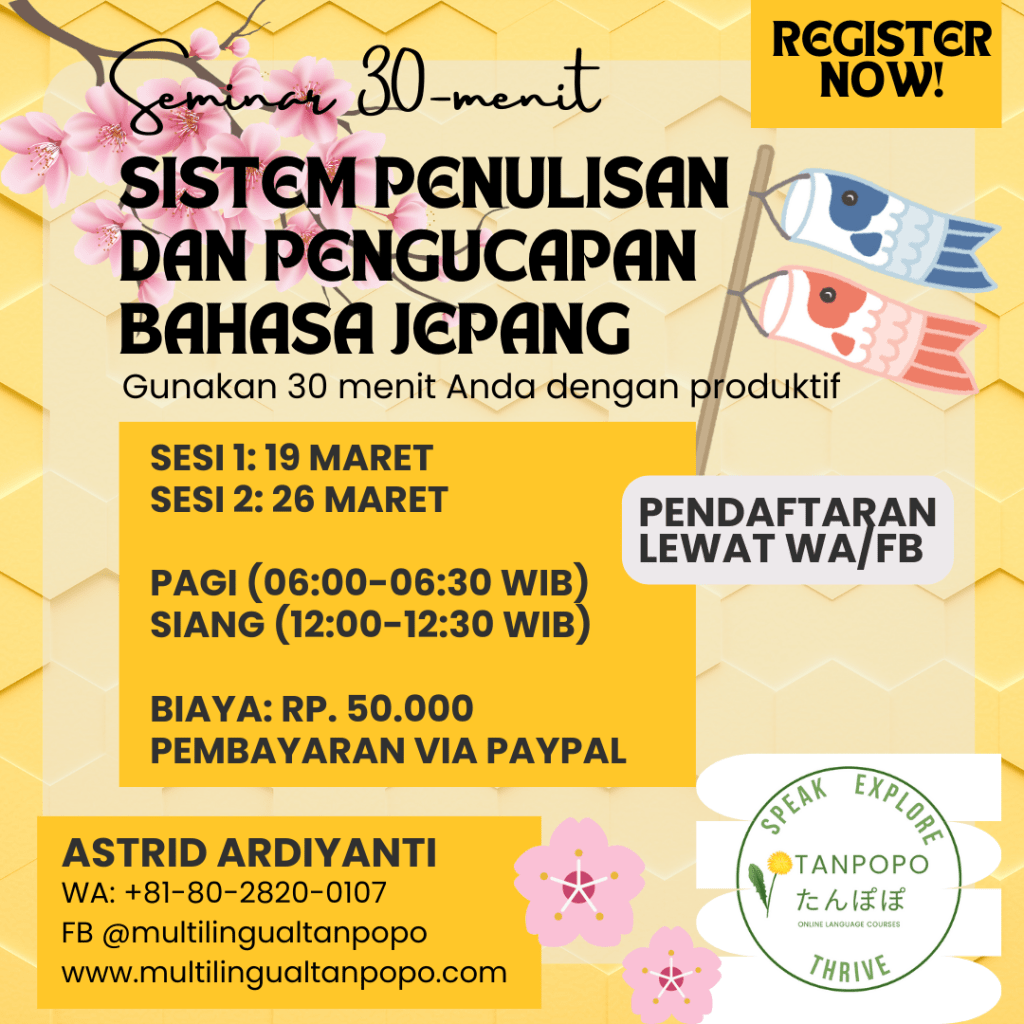
Apakah Anda tertarik untuk mengenal sistem penulisan dan pengucapan bahasa Jepang? Silahkan bergabung di seminar 30-menit saya di Zoom. Seminar ini bisa Anda ikuti di pagi hari sebelum Anda mulai rutinitas sehari-hari atau di jam istirahat siang. Gunakan waktu Anda dengan produktif untuk meningkatkan skill bahasa Anda.

Topik seminar:
• Sistem Penulisan: Pelajari dasar-dasar hiragana, katakana, dan kanji, serta bagaimana menggunakannya dalam berbagai konteks.
• Pengucapan yang Benar: Temukan kunci untuk mengucapkan kata-kata Jepang dengan benar dan lancar.
• Lafal yang berbeda dengan Bahasa Indonesia: Pelajari perbedaan antara bunyi-bunyi dalam bahasa Jepang yang dapat membantu Anda berbicara dengan lebih natural.

Jadwal:
Sesi 1: Pengenalan jenis huruf dan bunyi dasar di Bahasa Jepang
Tanggal 19 Maret (Selasa)
06:00-06:30 WIB dan jam 12:00-12:30 WIB (pilih salah satu)

Sesi 2: Pengenalan modifikasi bunyi di Bahasa Jepang
Tanggal 26 Maret (Selasa)
06:00-06:30 WIB dan jam 12:00-12:30 WIB (pilih salah satu)

Zoom link: dikirim ke WA atau email Anda

Biaya: Rp. 50.000

Cara daftar:
Kirim pesan ke saya (Astrid) untuk dapatkan link Zoomnya.

Kontak: +81-80-2820-0107 (WA)

Dengan biaya kurang lebih seharga satu gelas Frappucino dan menyediakan 30 menit di pagi hari saat otak dan fisik Anda masih sangat fresh atau di siang hari di sela-sela jam istirahat kantor, Anda bisa menambah pengetahuan tentang Bahasa Jepang dan berlatih atau bertanya langsung ke saya.

Silahkan kontak saya kapan saja kalau perlu info lebih detail atau berminat untuk tanggal lain.

Sore deha, kyoushitsu de aimashou!
(Sampai jumpa di kelas saya!)

Selamat beraktivitas!

Astrid

Learning Resources

How Shadowing Improves Our Language Mastery

Some of you know that I was an in-house English-Japanese interpreter. I had no formal education that prepared me as a professional translator/interpreter, so what I usually did those days and still do until now to train myself is shadowing. I was a “consecutive interpreter”, meaning I listened to a speaker’s speech in the source language while taking notes. When the speaker stopped speaking, it was my turn to speak in the target language. However, in some cases where the speech contents were very simple and straightforward, I could do the interpretation almost simultaneously without taking notes and finish my sentence almost at the same time as the speaker. This is technically termed as “simultaneous interpretation”. I’m not going to go deeper about these two types of interpretations (consecutive vs. simultaneous), but the reason why I mentioned these terms relates to the shadowing techniques that I use.

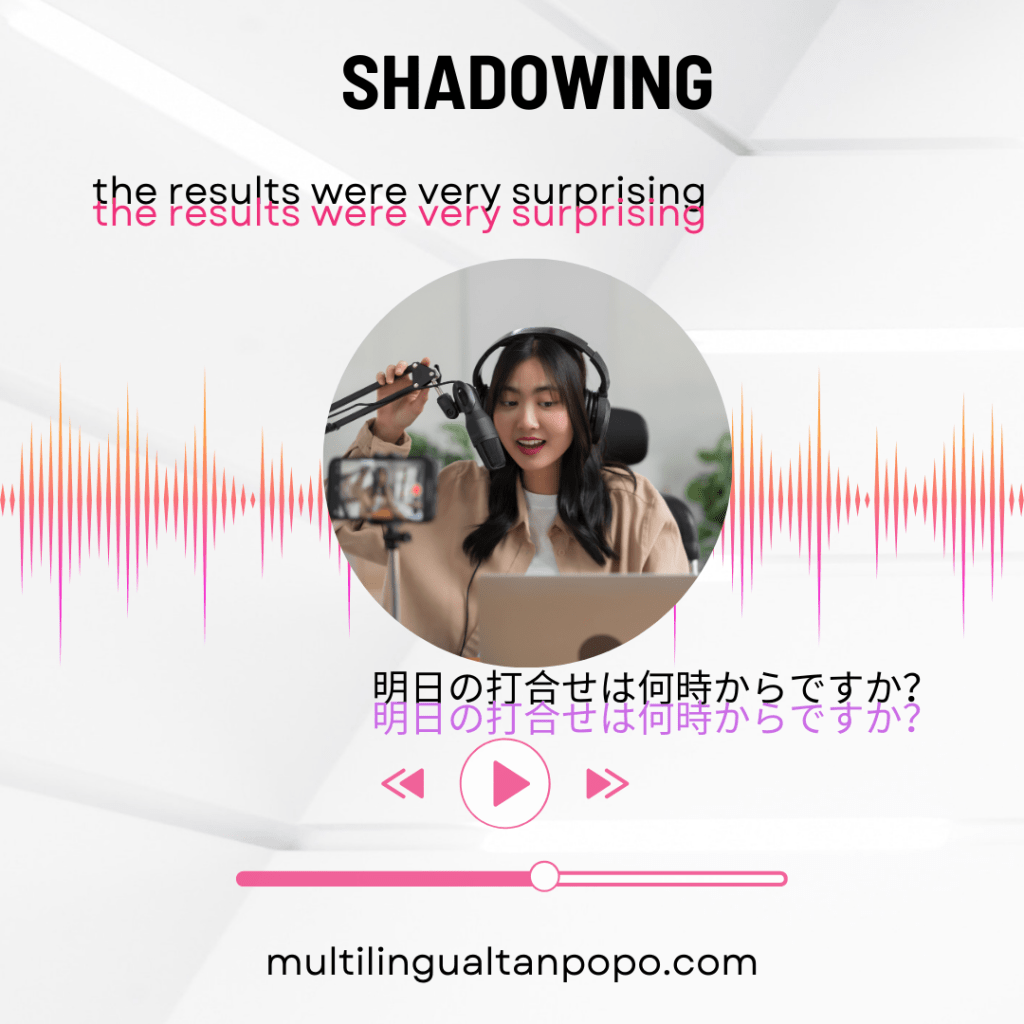
In shadowing, we listen to a speaker, who is usually a native speaker, and repeat the words and phrases the speaker says, trying to match his/her pronunciation and intonation as closely as possible. In my practice, I use both consecutive and simultaneous methods, although I’m not sure if there are such terms in shadowing. In the consecutive method, I listen to the speech, hit the pause button, replicate the speech, hit the play button again, and the same cycle continues. In the simultaneous method, I listen while replicating at the same time until I reach the point where I want to stop to review and repeat. If you are new to this practice, start with the consecutive one and move to the simultaneous one once you get a grip.

Here are some of the benefits of shadowing in language learning:

  1. Improves Pronunciation: One of the most significant benefits of shadowing is that it improves pronunciation. By mimicking a native speaker, you can learn to produce the sounds of the language more accurately and naturally.
  2. Enhances Listening Skills: Shadowing helps develop your listening skills because you must focus on the sounds of each word. It also can help you better understand the language and improve your comprehension abilities.
  3. Boosts Confidence: With regular shadowing practice, you will feel more comfortable conversing with native speakers in the target language, and, believe me, your confidence will keep building up.
  4. Provides Immediate Feedback: Shadowing provides immediate feedback, especially if you record your voice during practice. You can compare your pronunciation to that of the native speaker, quickly identifying areas where you need to improve and adjusting your speech accordingly.
  5. Helps with Fluency: Shadowing can also help you develop fluency in the language. By repeatedly practicing shadowing, you can improve your ability to communicate naturally and fluidly.

And you know what, I absolutely believe that singing along with your favorite singers is shadowing too! Even if you read or have memorized the lyrics by heart, you still listen while replicating the singer’s voice. We can call it “melodious shadowing”, maybe?

Despite all the benefits above, I must add some caution here, though, if your reference speech comes from drama, anime, or songs. You definitely can 100% mimic the words and intonation, as that is what shadowing exactly is, but be careful. Remember that the primary intention of shadowing is to practice your pronunciation and intonation. Know that because anime or song lyrics are a kind of art, they don’t necessarily apply the “standard” grammar or rules. Many are slang, dialects, wordplay, or other free-style types of sentences. So, again, use those materials to improve your pronunciation and intonation, but not as your grammar or level of politeness references, which are critical in Japanese daily and working culture. So, be mindful when choosing materials for your shadowing practice. Ensure that the materials align with the speech skills you aim for, e.g., do you want to practice speaking casually in daily conversation, formally in business settings, or like a professional YouTuber?

In conclusion, shadowing can enhance pronunciation, listening skills, confidence, fluency, and provide immediate feedback. Incorporating shadowing into your language learning routine can be a fun and engaging way to improve your language skills. So, give it a try and see how it can benefit you!

Happy learning!

Learning Resources

Essential Business Phrases for Workplace Communication

Mastering Japanese in general settings is an accomplishment, but navigating conversations with Japanese colleagues presents a unique challenge. Let’s look into three indispensable phrases commonly used in professional settings:

1. OTSUKARESAMA DESU (お疲れ様です) – This phrase is a staple in Japanese workplaces. It is used to greet colleagues and express acknowledgment of their hard work. Unlike “ohayou gozaimasu” or “konnichiha,” “otsukare sama desu” can be used at any time of the day, making it versatile for morning, afternoon, or evening interactions. While “ohayou gozaimasu” is still appropriate upon arrival in the morning, it is recommended to avoid using “konnichiha” or “konbanha” in business settings. In my nine years of working a corporate job, I have never heard anyone at work say “konbanha,” and probably only once or twice “konnichiha.”

2. OSEWA NI NARIMASU (お世話になります)- This phrase serves as a respectful opening in emails, particularly when addressing clients, customers, or employees from other companies. I’ve observed that in some cases, colleagues from different divisions within the same company use it. It signifies gratitude for the recipient’s support or assistance. The bottom line is, it’s important to note that “osewani narimasu” should be reserved for external contacts and not used with your immediate colleagues, as it may create a sense of distance.

3. YOROSHIKU ONEGAI SHIMASU (宜しくお願いします)- Commonly heard during self-introductions, “yoroshiku onegai shimasu” has multiple meanings depending on the context. Primarily, it is used when requesting a favor or asking someone to do something. For instance, you might use it to politely ask a colleague, “Can you submit this report by tomorrow? Yoroshiku onegai shimasu.” Additionally, in business emails, it functions as a courteous closing, akin to “best regards” or “sincerely yours.”. In this case, the politest version “yoroshiku onegai itashimasu (宜しくお願いいたします)” is commonly used.

There are many other commonly used business phrases, such as “otsukare sama deshita” (past form of otsukaresama deshita), “osewa ni natte orimasu”, and “osewa ni narimashita” (present continuous and past forms of “osewa ni narimasu”, respectively), which I’ll cover in my future posts.

Incorporating these phrases into your workplace communication can enhance professionalism and foster positive relationships with colleagues and clients alike.

Thank you for reading, and feel free to reach out if you need further examples or explanations. Have a productive day!

Learning Resources

Believe in your potential in learning a language

Q: I have no talent for learning languages. Do you think I can master Japanese?

A: Absolutely YES. Let’s forget that first sentence, and remove that idea from your head, too. Here’s the thing: If you can hear and speak, you can definitely learn a language. I speak two foreign languages fluently. Additionally, I’ve been learning Chinese and Korean for a few months. However, due to my inconsistencies and lack of effort, my proficiency in Chinese and Korean remains very low. Therefore, talent, ability, or skill are not the magic ingredient. Talent is the result of a long-term effort, meaning we create our own talents.

Now, you think or you believe you can’t. Some of the reasons are probably:

1) you haven’t tried enough,

2) you haven’t used the appropriate learning tools/methods,

and/or

3) you haven’t found a clear purpose for mastering the target language.

Address each relevant factor and see if you get closer to your goals.

Also, know that your thoughts are crucial. They dictate your actions. Therefore, change your words: I can try. I accept mistakes as they help me grow.

One tip: when you make mistakes, just (lovingly) slap your forehead once (or skip this step!), laugh, and move on.

Anyway, just breathe, smile, get back on the learning track, and try again with a better approach and positive mindset each time.  

Happy learning!

Learning Resources

Weekend rituals for wellness

Every day is a precious gift, and we should remind ourselves to slow down and enjoy the small joys that we often miss in our daily routine. Let’s make use of our weekends to engage in activities that bring us joy and peace, such as reading a good book, taking a leisurely stroll in a nearby park, or spending quality time with loved ones. These moments can become our anchors and help us maintain a sense of balance and well-being.

As a mother of three small children, weekends are the busiest days of the week for me. However, I try to stay grounded by being aware of my breathing and connecting with the present moment whenever I can. Our regular spots are libraries and playgrounds, but I also enjoy taking our children for walks in nature. To slow down and relax at home, I like to have a cup of tea with some light snacks, turn on my favorite songs, and sometimes even dance to the music.

What are your go-to weekend rituals for slowing down? Let’s create a community to inspire and encourage one another on our journey towards mindfulness. 🌿💖 #SlowLiving #WeekendWellness #MindfulLiving