

Some of you know that I was an in-house English-Japanese interpreter. I had no formal education that prepared me as a professional translator/interpreter, so what I usually did those days and still do until now to train myself is shadowing. I was a “consecutive interpreter”, meaning I listened to a speaker’s speech in the source language while taking notes. When the speaker stopped speaking, it was my turn to speak in the target language. However, in some cases where the speech contents were very simple and straightforward, I could do the interpretation almost simultaneously without taking notes and finish my sentence almost at the same time as the speaker. This is technically termed as “simultaneous interpretation”. I’m not going to go deeper about these two types of interpretations (consecutive vs. simultaneous), but the reason why I mentioned these terms relates to the shadowing techniques that I use.
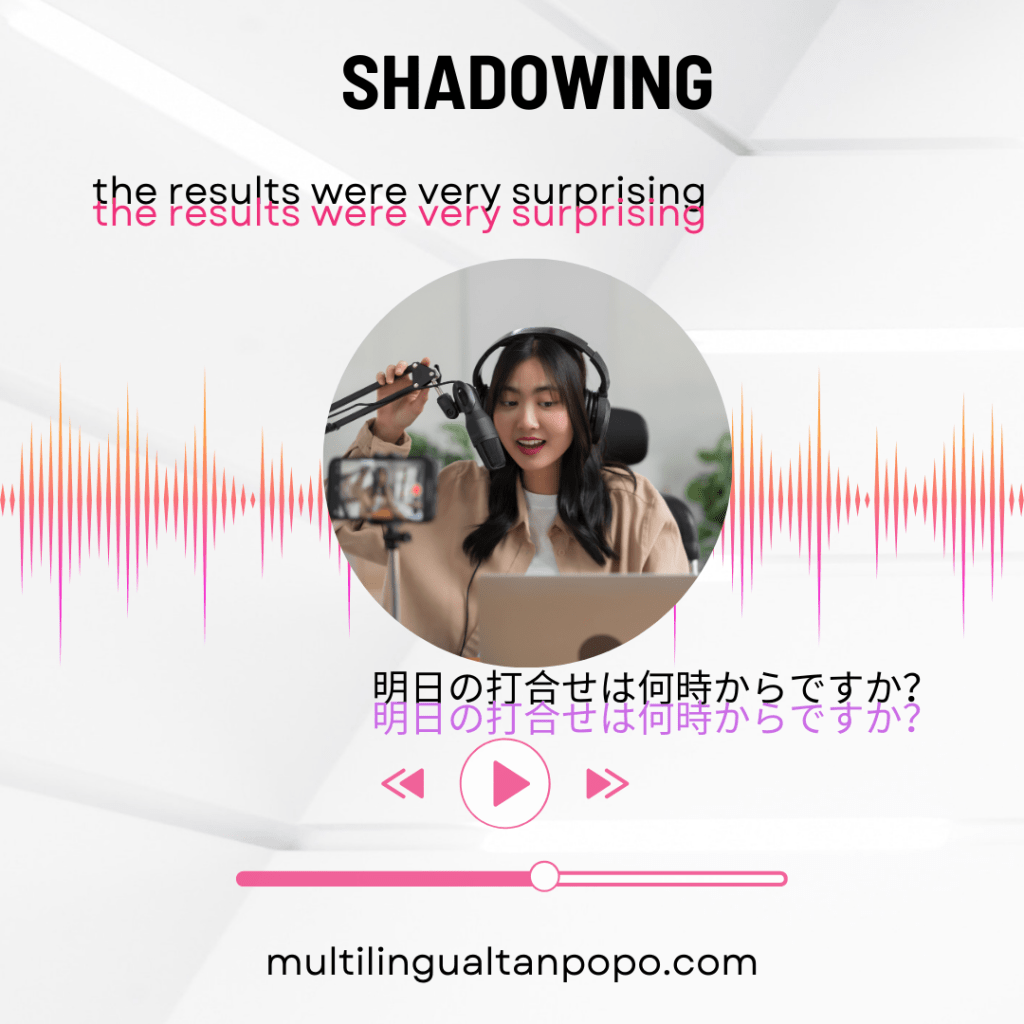
In shadowing, we listen to a speaker, who is usually a native speaker, and repeat the words and phrases the speaker says, trying to match his/her pronunciation and intonation as closely as possible. In my practice, I use both consecutive and simultaneous methods, although I’m not sure if there are such terms in shadowing. In the consecutive method, I listen to the speech, hit the pause button, replicate the speech, hit the play button again, and the same cycle continues. In the simultaneous method, I listen while replicating at the same time until I reach the point where I want to stop to review and repeat. If you are new to this practice, start with the consecutive one and move to the simultaneous one once you get a grip.
Here are some of the benefits of shadowing in language learning:
- Improves Pronunciation: One of the most significant benefits of shadowing is that it improves pronunciation. By mimicking a native speaker, you can learn to produce the sounds of the language more accurately and naturally.
- Enhances Listening Skills: Shadowing helps develop your listening skills because you must focus on the sounds of each word. It also can help you better understand the language and improve your comprehension abilities.
- Boosts Confidence: With regular shadowing practice, you will feel more comfortable conversing with native speakers in the target language, and, believe me, your confidence will keep building up.
- Provides Immediate Feedback: Shadowing provides immediate feedback, especially if you record your voice during practice. You can compare your pronunciation to that of the native speaker, quickly identifying areas where you need to improve and adjusting your speech accordingly.
- Helps with Fluency: Shadowing can also help you develop fluency in the language. By repeatedly practicing shadowing, you can improve your ability to communicate naturally and fluidly.
And you know what, I absolutely believe that singing along with your favorite singers is shadowing too! Even if you read or have memorized the lyrics by heart, you still listen while replicating the singer’s voice. We can call it “melodious shadowing”, maybe?
Despite all the benefits above, I must add some caution here, though, if your reference speech comes from drama, anime, or songs. You definitely can 100% mimic the words and intonation, as that is what shadowing exactly is, but be careful. Remember that the primary intention of shadowing is to practice your pronunciation and intonation. Know that because anime or song lyrics are a kind of art, they don’t necessarily apply the “standard” grammar or rules. Many are slang, dialects, wordplay, or other free-style types of sentences. So, again, use those materials to improve your pronunciation and intonation, but not as your grammar or level of politeness references, which are critical in Japanese daily and working culture. So, be mindful when choosing materials for your shadowing practice. Ensure that the materials align with the speech skills you aim for, e.g., do you want to practice speaking casually in daily conversation, formally in business settings, or like a professional YouTuber?
In conclusion, shadowing can enhance pronunciation, listening skills, confidence, fluency, and provide immediate feedback. Incorporating shadowing into your language learning routine can be a fun and engaging way to improve your language skills. So, give it a try and see how it can benefit you!
Happy learning!

 TANPOPO